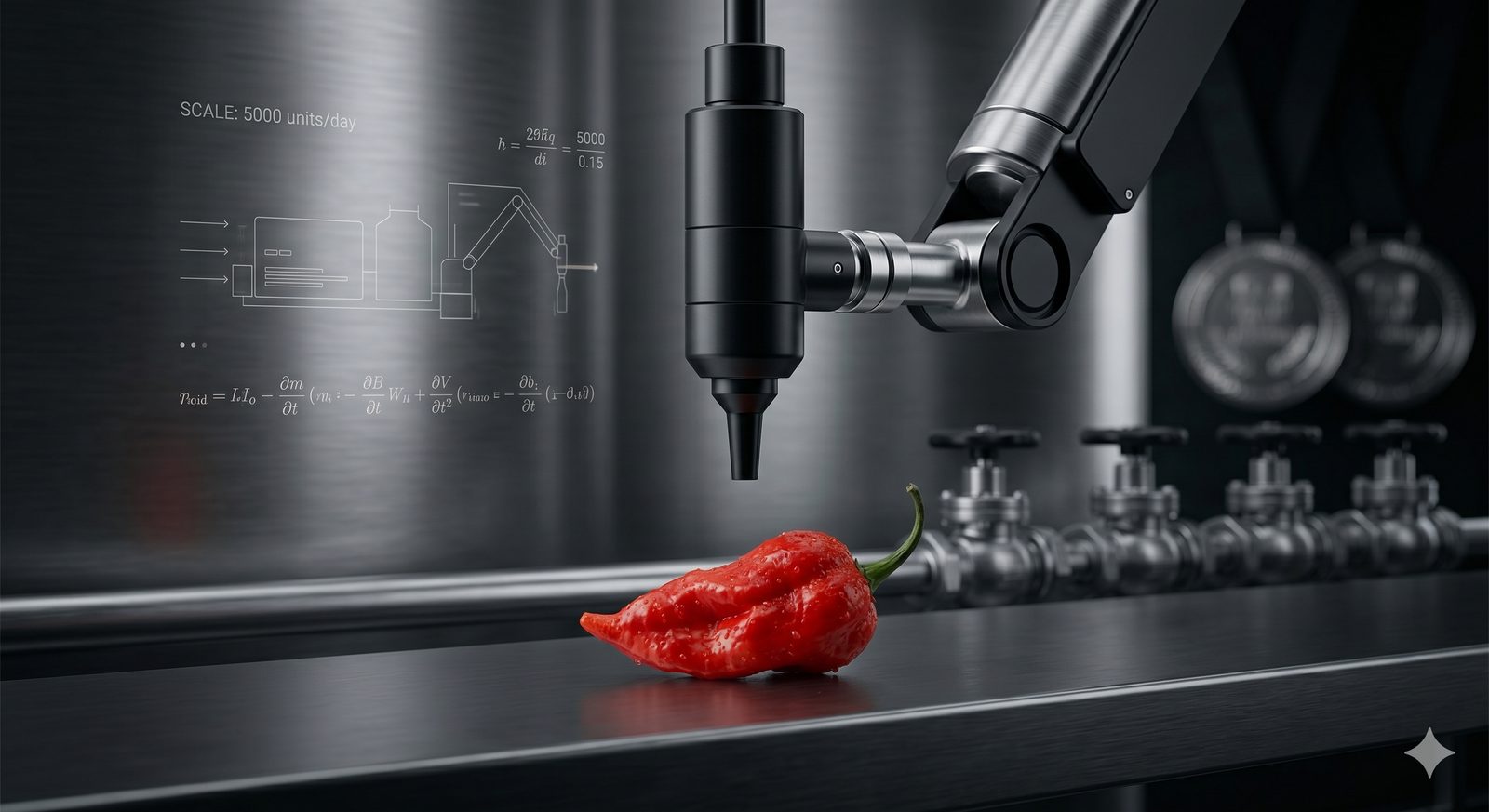
Everyone falls in love with the recipe. The recipe is the fun part — the moment in the kitchen when the balance is finally right and the heat builds exactly the way you wanted. But a recipe that works once, for one jar, is a long way from a product you can make five thousand times a day, identically, safely and profitably.
The gap between those two things is where most food businesses quietly struggle. Here's what actually has to be solved when you scale a chilli sauce — using the ghost pepper, because few ingredients punish a sloppy process more.
1Consistency is the whole game
A ghost pepper (bhut jolokia) is not a standardised input. Its heat varies with the season, the soil, the rainfall, even which part of the plant the fruit came from. In a home kitchen you taste and adjust. On a line running thousands of units, "taste and adjust" doesn't scale — and the customer who loved batch one will abandon you if batch four is noticeably milder or blows their head off.
So the first real task isn't cooking. It's defining the target and measuring against it. You need a specification for the finished product — heat, acidity, salt, viscosity, colour — and a way to test incoming chillies and blend toward that spec regardless of how the raw material varies. That's the difference between a cook and a manufacturer: the manufacturer designs out the variability the ingredient brings in.
A great recipe is a moment. A great product is the same moment, repeated ten thousand times, on purpose.
2Food safety isn't optional, and acid is your friend
Sauces are a controlled product for good reason. Get preservation wrong and you're not facing a bad review — you're facing a recall, or worse. For an acidified product like a chilli sauce, controlling pH is central: keep it acidic enough, reliably enough, and you create an environment hostile microbes can't survive in.
At small scale you might get away with rough judgement. At commercial scale you need validated process controls — measured pH at defined points, proper thermal processing, a hot-fill or equivalent step, and records that prove every batch met the standard. This is the part founders most underestimate, and it's non-negotiable.
3The supply chain decides whether you can even make the promise
Promising 5,000 bottles a day means promising the chillies, the bottles, the caps, the labels and the cartons to match — every day, on time. A shortage of any one stops the whole line. Ghost peppers in particular are seasonal and regional, so you're managing a perishable, variable input against steady production demand.
That forces decisions: how do you preserve or process chillies in season to use through the year — mash, paste, frozen? How much buffer stock of packaging against supplier delays? Where are your single points of failure? Unglamorous questions that determine whether your beautiful product actually ships.
4The line itself changes the product
Equipment isn't neutral. Cooking a hundred litres in a jacketed vessel behaves differently from a pot on a stove — heat transfer, evaporation and mixing all shift, and the product shifts with them. Capsaicin, the compound behind the heat, is stubborn: it clings to equipment and lingers, which matters enormously if you run other products on the same line.
So scaling isn't "the same recipe, bigger." It's re-developing the recipe for the equipment it will actually be made on, then locking that process down. The version that wins the kitchen taste test is the starting point, not the finished article.
5The real lesson
None of this is as romantic as the recipe. But it's where products live or die. The makers who scale successfully fall in love not just with how their product tastes, but with the boring, rigorous systems that let it taste that way every single time. Get those right and the heat takes care of itself.
That shift — from cook to manufacturer, from recipe to repeatable product — is one of the most valuable transitions a food business can make. It's also one of the hardest to make alone.