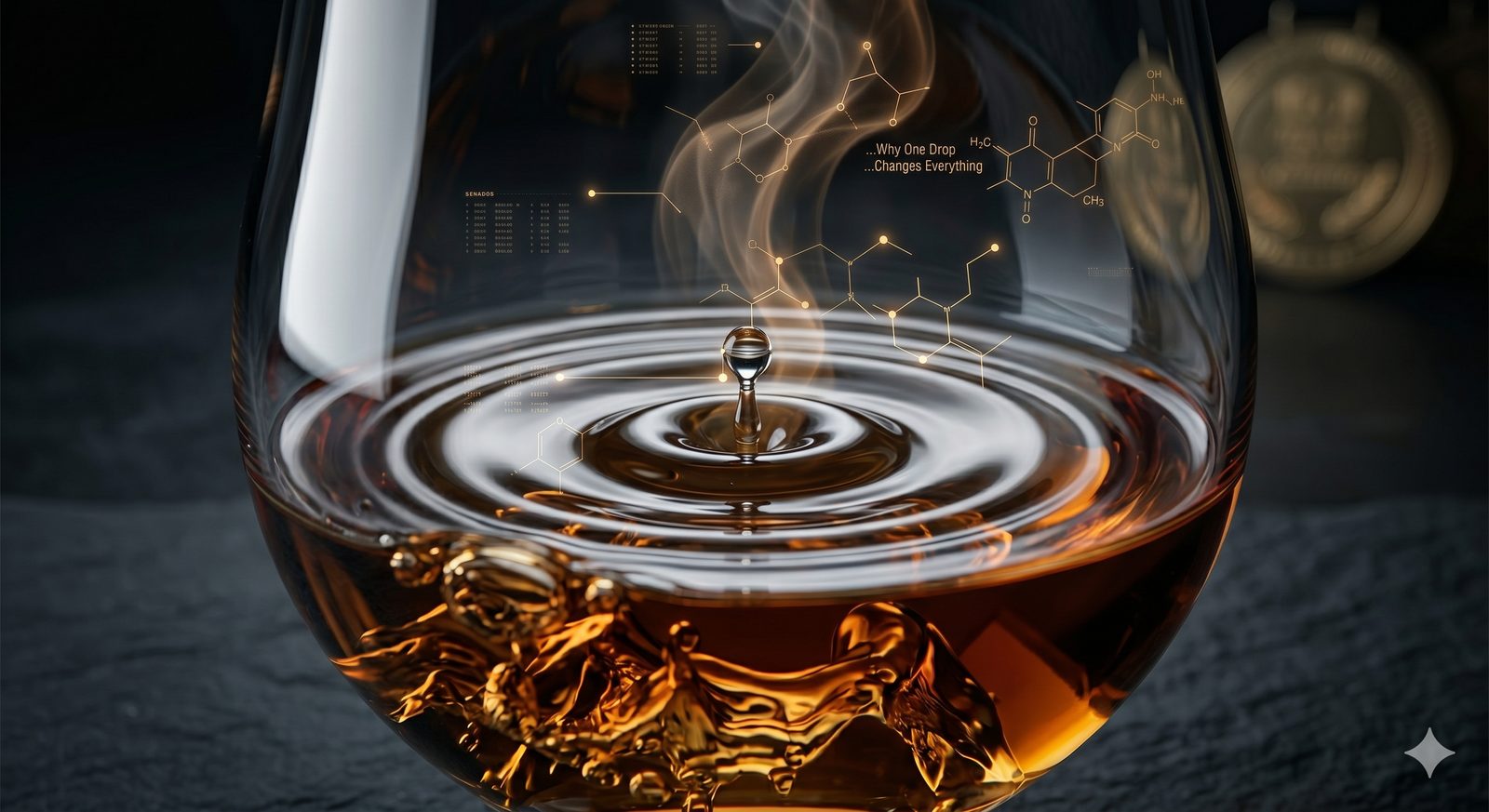
Sit with a serious whisky drinker and, sooner or later, someone adds a drop of water and says the dram "opened up." It sounds like ritual. It is, in fact, physics and chemistry doing something rather elegant — and once you understand it, you taste differently forever.
I came to spirits through the science of liquids: how molecules behave in solution, how they move to a surface, how we actually perceive them. So let me take you under the surface of the glass — no jargon you can't use at the next tasting.
1A whisky is mostly two liquids having an argument
Strip it back and a cask-strength malt is water, ethanol, and a tiny fraction — often less than 1% — of the aroma compounds that carry all the character: fruit, smoke, vanilla, spice. That tiny fraction is the entire show. The water and ethanol are the stage it stands on.
Here's the key: many of those aroma molecules would rather sit at the surface of the liquid, where they can evaporate into your nose. But at high alcohol strength, ethanol keeps them dissolved and held down in the body of the liquid. The aromas are there — they just can't escape to be smelled.
At cask strength, the perfume is locked in the bottle of the liquid itself. Water is the key that lets it out.
2What the drop of water actually does
Add a little water and you lower the alcohol concentration. With less ethanol to hold them, aroma molecules — guaiacol (smoke), esters (fruit), oak lactones (coconut and vanilla) — migrate to the surface and lift off into the air above the glass. You literally smell more. At the same time, the harsh nose-prickle of raw ethanol drops away, so your senses aren't being shouted over.
There's a sweet spot. Too little water and it stays locked up; too much and you've simply diluted the aromas into a weak, flat dram. Move the slider below and find it.
3Why this matters beyond the party trick
Three things follow once you see the mechanism:
- Cask strength isn't "better" — it's adjustable. A high-strength bottle gives you control over where the dram performs best. That flexibility is part of what collectors are really paying for.
- Glassware is doing chemistry too. A narrow rim concentrates those surface aromas; a wide tumbler lets them disperse. The shape changes the experience as much as the liquid.
- Your nose, not your tongue, is most of the flavour. The tongue gives you sweet, salt, sour, bitter and texture. The hundreds of nuances — orchard fruit, leather, sea-spray — arrive through the aroma route. That's why "opening up" the nose changes the whole tasting.
4How to taste like you mean it
Next time you have something worth the attention: nose it first at full strength and note what you get. Add a few drops of still water, swirl, and nose again — the difference is often startling. Then add a little more and find the point where it's most expressive for you. There's no correct answer, only your sweet spot. That's not snobbery; it's an experiment you run with your own senses.
Understanding the why doesn't take the romance out of a great glass. If anything, it deepens it — because you start to taste the craft, the cask and the chemistry all at once.